Tile Adhesive: The Complete Guide to Choosing and Using the Best Tile Adhesive in India
If you are planning to renovate your home or build a new space, tile adhesive is one of the most important materials you will buy. Tiles look beautiful, but it is the tile adhesive underneath that decides whether your floor stays flat, firm, and crack-free for years. A poor choice leads to hollow sounds, loose tiles, and expensive repair work. A good one gives you a floor you never have to think about again.
In this guide, we explain what tile adhesive is, why it has replaced the old sand-cement method, how to pick the right product, and how to apply it step by step. We also look at Starx 510, a popular tile adhesive made for ceramic and vitrified floor tiles.
What Is Tile Adhesive?
Tile adhesive is a factory-made bonding material used to fix tiles on floors and walls. It is usually a ready-to-mix powder made from cement, graded sand or minerals, and special polymers. When you mix it with clean water, it turns into a smooth paste that you spread on the surface with a notched trowel. The tile is then pressed into the paste, and once it sets, it holds the tile firmly in place.
The polymers are what make modern tile adhesive different from plain cement mortar. They improve flexibility, water retention, and bond strength, so the tile stays attached even when the floor goes through small movements, temperature changes, or heavy foot traffic.
Why Tile Adhesive Is Better Than Sand-Cement Mortar
For decades, Indian masons laid tiles on a thick bed of sand and cement. It works, but it has real limitations, and this is why most professionals now prefer tile adhesive.
- Stronger bond: Tile adhesive contains polymers that grip both the tile and the surface. Sand-cement mortar depends only on cement hydration, which is weaker and less consistent.
- Thin bed, faster work: Tile adhesive is applied in a thin bed of around 3 mm, while mortar needs a thick bed of 20 to 30 mm. This saves material and speeds up the job.
- Consistent quality: Because tile adhesive is made in a factory, the mix ratio is the same in every bag. Hand-mixed mortar changes with every batch.
- Less water curing: Most good tile adhesives do not need days of water curing, which means quicker project completion.
- Fewer hollow tiles: Full contact between the tile and the adhesive bed reduces hollow spots, the main cause of cracked and lifted tiles.
- Better for vitrified tiles: Vitrified tiles absorb very little water, so they need a polymer-modified tile adhesive to bond properly.
Types of Tile Adhesive
Not every tile adhesive is made for every job. Knowing the main types helps you avoid mistakes.
- Floor tile adhesive: Designed for interior floors where tiles must handle foot traffic and weight. Products such as Starx 510 floor tile adhesive fall in this category.
- Wall tile adhesive: Formulated with higher slip resistance so tiles do not slide down while the adhesive sets.
- Heavy-duty or polymerized adhesive: Used for large-format tiles, stone, and difficult substrates where extra bond strength is needed.
- Block adhesive: Used for fixing AAC blocks instead of ordinary mortar, giving thinner joints. See our block adhesive.
- Epoxy-based adhesive and grout: Chemical-resistant, waterproof options for special areas like kitchens, labs, and industrial floors.
How to Choose the Right Tile Adhesive
Before you buy any tile adhesive, check these points.
- Application area: Is it a floor or a wall? Inside or outside? A tile adhesive made for interior floors should not be used on exterior walls.
- Tile type: Ceramic, vitrified, natural stone, and porcelain each have different absorption levels. Read the label to confirm the adhesive supports your tile.
- Substrate: Most Indian floors are cement mortar beds, cement plaster, or cement terrazzo. Make sure the adhesive suits your surface.
- Coverage: A cheaper bag that covers less area can cost more in the end. Compare tile adhesive price per square foot, not just per bag.
- Pot life and setting time: A longer pot life gives installers more time to adjust tiles.
- Manufacturer: Choose a company that controls quality in its own plant and offers technical support.
Starx 510 Floor Tiles Adhesive: A Reliable Tile Adhesive for Interior Floors
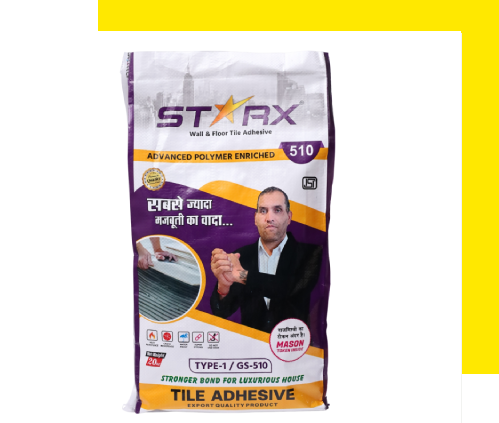
Starx 510 is a premium tile adhesive made with cement, polymers, natural minerals, and aggregates. It is made for fixing ceramic and vitrified tiles on interior floors, and it is manufactured by Starx Product in Delhi. It comes in a convenient 20 kg grey bag.
- High bond strength: A strong grip that reduces hollow tiles and debonding.
- No shrinkage: The adhesive layer stays stable as it sets, so tiles stay level.
- Economical coverage: One 20 kg bag covers approximately 55 to 60 sq ft with a 6 mm x 6 mm square-notch trowel at a 3 mm bed thickness.
- Long pot life: Workable for up to 45 minutes and usable within one hour of mixing.
- Sets in 24 hours: At around 30°C, the adhesive sets fully within a day.
- Zero wastage and single pack: Just add water. No extra additives needed.
- No curing required: Saves time and effort on the project.
Important: Starx 510 is for internal floors only, on cement mortar bed, cement plaster, and cement terrazzo. For walls or outdoor areas, choose a tile adhesive from the Starx 515 or 525 range. View full specifications on the Starx 510 Floor Tiles Adhesive page.
Step-by-Step: How to Apply Tile Adhesive on a Floor
Even the best tile adhesive will not perform if it is applied badly. Follow these steps for a professional result.
Step 1: Prepare the surface
The surface must be clean, firm, and free from dust, oil, grease, loose particles, and standing water. Level uneven floors first. Good surface preparation is the single biggest factor in how long your tile adhesive bond lasts.
Step 2: Mix the tile adhesive
Pour clean water into a clean container and add the powder slowly while mixing. Stir until you get a smooth, lump-free paste. Mix only as much as you can use within the pot life.
Step 3: Spread the adhesive
Apply a thin layer with the flat side of the trowel, then comb it with the notched side to create even ridges. For Starx 510, use a 6 mm x 6 mm square-notch trowel to achieve a 3 mm bed.
Step 4: Place and align the tile
Press the tile down with a slight twisting motion and tap gently with a rubber mallet so it sits level with full contact. Use spacers for even joints. Within the pot life window, you can still lift and adjust a tile.
Step 5: Let it set and grout
Do not walk on the floor for at least 24 hours. Setting time can vary with temperature, humidity, and air flow. Once set, fill the joints with tile grout for a clean finish.
Tile Adhesive Coverage and Cost: What to Expect
Coverage depends on trowel size, bed thickness, and surface condition. With Starx 510, a 20 kg bag covers roughly 55 to 60 sq ft, so a 600 sq ft room needs around 10 to 11 bags. Add a buffer of 5 to 10 percent for uneven areas and cutting.
When comparing tile adhesive price across brands, calculate the cost per sq ft rather than the bag price. A tile adhesive with better coverage and less wastage often works out cheaper overall.
Common Mistakes to Avoid When Using Tile Adhesive
- Using the wrong product: A floor tile adhesive on an exterior wall, or the opposite, leads to failure.
- Adding too much water: Extra water weakens the bond and causes shrinkage.
- Mixing too much at once: If the mix starts to harden, do not add water to revive it. Mix a fresh batch.
- Skipping surface preparation: Dust and oil stop the tile adhesive from gripping.
- Walking on the floor too early: Give the adhesive its full setting time.
Where Is Tile Adhesive Used?
Tile adhesive is used almost everywhere tiles are used. In homes, it fixes tiles in living rooms, bedrooms, kitchens, and bathrooms. In commercial spaces, it is used in offices, showrooms, hotels, malls, and hospitals. Builders and contractors prefer it for large projects because it saves time, reduces labor cost, and gives a uniform finish across hundreds of units. Whatever the project, always match the product to the surface and the tile you are fixing.
Storage and Handling Tips for Tile Adhesive
Good results start before the bag is opened. Store every bag of tile adhesive in a dry place, raised off the ground on wooden pallets and away from walls, because moisture can start the hardening process inside the bag. Keep bags closed when not in use, and use older stock first. Never use tile adhesive that has formed lumps in the bag.
On site, use clean buckets and tools for every batch. Old, dried material in a bucket can spoil a fresh mix and reduce bond strength. Wear gloves and a dust mask while mixing, since cement-based powders can irritate the skin and lungs. If the weather is very hot or windy, work in smaller sections so that the adhesive does not form a skin before the tile is placed.
Frequently Asked Questions About Tile Adhesive
What is tile adhesive used for?
Tile adhesive is used to fix ceramic, vitrified, porcelain, and stone tiles on floors and walls with a strong, long-lasting bond.
Is tile adhesive better than cement?
Yes. Tile adhesive contains polymers that give higher bond strength, better flexibility, and consistent quality compared to ordinary sand-cement mortar.
How long does tile adhesive take to set?
Starx 510 sets in about 24 hours at 30°C. Weather conditions can slightly change this time.
How much area does one bag of tile adhesive cover?
A 20 kg bag of Starx 510 covers approximately 55 to 60 sq ft at a 3 mm bed thickness.
Can I use floor tile adhesive on walls?
No. Starx 510 is for internal floors only. Use a wall-grade tile adhesive for vertical surfaces.
Do I need skilled labor to apply tile adhesive?
No. With standard tools, regular tile workers can apply it without special training.
Conclusion: Choose the Right Tile Adhesive for a Floor That Lasts
Your tiles are only as good as the tile adhesive holding them down. Choose a polymer-modified product that suits your tile type and surface, prepare the base properly, and follow the correct mixing and application method to avoid hollow tiles, cracks, and costly rework.
For interior ceramic and vitrified floors, Starx 510 is a dependable tile adhesive that offers high bond strength, economical coverage, a generous pot life, and zero wastage, all in a simple 20 kg pack.
Need the Right Tile Adhesive for Your Project?
Starx Product manufactures and supplies tile adhesive from Mundka Industrial Area, Delhi. Our team will help you pick the right product.
Enquiry Now +91 93116 43257