Tile Chemical Manufacturer: How to Choose the Right One for Your Tiling Job
Ask any contractor what ruins a finished room, and you will hear the same story. The tiles looked perfect on day one. Then, a few months later, someone hears a hollow sound underfoot, a corner lifts, or a crack runs across a brand new floor. Most of the time, the tile itself is not the problem. The material holding it down is. That is exactly why choosing a good Tile Chemical Manufacturer matters just as much as choosing the tile.
Whether you are a homeowner planning a bathroom makeover, a builder handling fifty flats, or a dealer stocking up for the season, this guide walks you through what to look for. We will keep it practical. No jargon for the sake of it, just the things that actually affect how your tiling job turns out.
What Does a Tile Chemical Manufacturer Actually Make?
The phrase sounds technical, but the idea is simple. A Tile Chemical Manufacturer produces the materials that sit around and beneath your tiles. The most important of these is tile adhesive, the powder you mix with water and spread on the surface before pressing tiles in place. Beyond that, the same factory usually makes tile grout for the joints, epoxy grout for areas that see moisture or stains, block adhesive for lightweight masonry, and cleaners for the finished surface.
Think of it as the hidden layer of every tiled room. Nobody admires adhesive once the job is done, yet everything you can see depends on it. A good manufacturer blends cement, polymers, natural minerals and fine aggregates in controlled ratios, so every bag behaves the same way on site. That consistency is what you are really paying for.
Why Builders Are Moving Away from Sand-Cement Mortar
For decades, tile fixing meant mixing sand and cement by hand and laying a thick bed. It works, and plenty of old buildings prove it. But it also has real weaknesses. Mixing ratios change from one labourer to the next. The bed needs curing. Thick layers add weight and use more material than you would think. And because the bond is mostly mechanical, tiles can develop hollow spots that only show up later.
A polymer-modified adhesive from a proper Tile Chemical Manufacturer fixes most of these headaches. The mix is factory-made, so the ratio is the same in every bag. The bed is thin, usually around 3 mm, which saves material and reduces dead weight on slabs. The polymers improve grip and flexibility, which means tiles are far less likely to debond or sound hollow after a few months. For most interior work, the switch pays for itself in fewer callbacks alone.
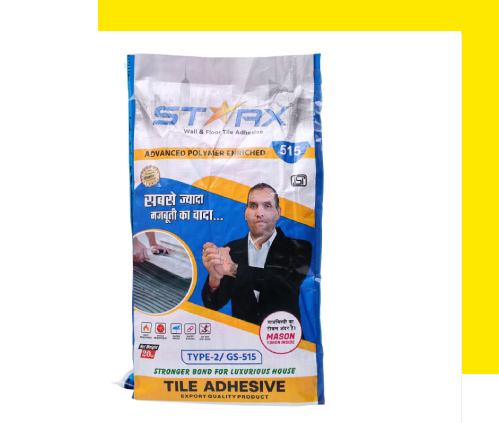
Starx 515 & 515 Max comes in a 20 kg bag, ready to mix with water.
What to Look for in a Tile Chemical Manufacturer
Not every supplier is built the same. Some simply repack material made elsewhere, while others run their own production and test what they ship. Before you place an order, especially a bulk one, run through the points below.
Consistent batches
A single great bag means nothing if the next one behaves differently. Ask how the manufacturer checks pot life, bond strength and setting time from batch to batch. A serious Tile Chemical Manufacturer will have a clear answer, and will not be offended that you asked.
Clear technical data
You should be able to get a technical data sheet before buying. It should state coverage, recommended trowel size, bed thickness, pot life, setting time and the surfaces the product is meant for. If a supplier cannot tell you these numbers, treat that as a warning sign.
A range that matches your jobs
Interior walls and floors, exterior facades, heavy-duty areas, block work and grouting all need slightly different products. A manufacturer with a full range lets you buy everything from one place and get advice that fits the entire job instead of one bag.
Direct support
Site problems rarely follow the textbook. Weather, surface condition and tile size all change how an adhesive behaves. When you can call the manufacturer directly and talk to the technical team, you solve problems in minutes instead of days.
How to Read Tile Adhesive Specifications
Spec sheets can look intimidating, but there are only a handful of numbers that really matter. Here is what each one tells you in plain language.
- Coverage: how much area one bag will cover at a given bed thickness. It helps you estimate quantity and cost per square foot.
- Notch trowel size: the trowel controls how much adhesive stays on the surface. Using the wrong size changes both coverage and bond.
- Bed thickness: the layer of adhesive under the tile. Thin-bed adhesives are designed to work at a few millimetres, not several centimetres.
- Pot life: how long the mixed adhesive stays workable. It decides how much you can mix at a time.
- Setting time: how long before the tiles can be left alone and, later, grouted.
- Application area: whether the product is meant for interior or exterior use, floors, walls or both.
Remember that site conditions shift these numbers a little. High humidity, low temperatures or strong wind can all change pot life and setting time, so always treat published figures as a guide rather than a stopwatch.
A Closer Look at Starx 515 & 515 Max
To make this concrete, let us look at one of our most popular products. Starx 515 & 515 Max is a premixed, single-pack adhesive made from cement, high-grade polymers, natural minerals and selected aggregates. It is designed for fixing ceramic and vitrified tiles on interior floors and walls, which makes it a practical pick for homes, offices, showrooms and hotel interiors. You can read the full technical details on our Tile Chemical Manufacturer product page.
Here is what you can expect from it on site:
- A 20 kg bag covers roughly 55 to 60 sq ft with a 1/4" × 1/4" (6 mm × 6 mm) square-notch trowel at a 3 mm bed.
- Pot life is up to 45 minutes, and the mixed adhesive should be used within an hour.
- It sets within 24 hours at around 30°C ambient temperature.
- It bonds to cement mortar beds, cement plaster and cement terrazzo.
- Ordinary site labour can apply it with standard tools, and no extra additives are needed.
It is available in grey and white, and the formula is made for both walls and floors, so one product covers a whole interior job. That also means less stock to manage on site, which contractors tend to appreciate.
One honest note: this grade is for internal use only. If you are tiling exteriors or heavy-duty areas, our 525, 535 and 545 grades are the better fit. Using the right grade for the right place is far more important than choosing the strongest-sounding name.
Common Tile-Fixing Mistakes and How to Avoid Them
Even the best adhesive can fail if it is used carelessly. These are the mistakes we see most often, and all of them are easy to avoid.
Skipping surface preparation
Dust, grease, loose particles and standing water all weaken the bond. Clean the surface properly before you start. It takes ten minutes and saves a lot of regret.
Mixing too much at once
Once the pot life runs out, the adhesive stops bonding well. Mix what your crew can lay within the working time, and never add water to revive a stiffened mix.
Using the wrong trowel
A trowel that is too small leaves gaps under the tile, while one that is too large wastes material. Stick to the size recommended on the data sheet and press each tile firmly so it makes full contact with the bed.
Grouting too early
Give the adhesive time to set fully before filling the joints. Rushing this step can disturb tiles that have not yet taken hold. When the time comes, a matching tile grout gives you a clean, finished line.
Picking by price alone
A cheaper bag that covers less area or fails early costs more in the end. Compare coverage, support and consistency, not just the number on the invoice.
Choosing the Right Grade for the Right Place
A simple way to plan is to start from where the tile is going. For interior floors and walls in dry or normally humid rooms, 515 & 515 Max is the straightforward choice. For exterior or demanding areas, move up to the 525, 535 or 545 range. For block work, use a dedicated block adhesive. And for joints and cleaning, finish with the grout and cleaner that suit the tile. A Tile Chemical Manufacturer with a complete range makes this planning easy, because one conversation can cover the whole project.
Final Thoughts
Tiles are an investment, and the material underneath them quietly decides how long that investment lasts. Look for a manufacturer that makes its own product, tests every batch, shares clear specifications and picks up the phone when you need help. If you want to see how that looks in practice, explore Starx 515 & 515 Max from Starx, a Tile Chemical Manufacturer based in Mundka, Delhi, and ask our team for the data sheet before your next order.
Planning a Tiling Project?
Talk to our technical team about the right adhesive grade, quantity and application advice for your site.
Enquiry Now +91 93116 43257