Tile Adhesive: How to Choose the Right One for Floors, Walls and Every Tile Type
Quick answer: Tile adhesive is a factory-made, polymer-enriched cement powder that you mix with water and spread in a thin bed of about 3 mm to fix ceramic and vitrified tiles on floors and walls. It bonds better and more consistently than hand-mixed sand-cement mortar.
How to choose: match the grade to the location (interior or exterior), check coverage per bag, pot life and setting time, and use the trowel size on the data sheet. For interior ceramic and vitrified tiles, Starx 515 & 515 Max covers about 55–60 sq ft per 20 kg bag.
A tiled room looks permanent, but its life depends on a layer you never see. The wrong tile adhesive shows up months later as a hollow sound underfoot, a lifted corner or a hairline crack that wasn't there on handover day. The right one disappears behind the tile and does its job for years. That is why choosing tile adhesive deserves more attention than it usually gets.
This guide is written for homeowners, contractors, interior designers and dealers. It explains what tile adhesive is, how it differs from the old sand-cement method, which specifications matter, how much to buy, how to apply it properly and where people go wrong. We also look at our own Starx 515 & 515 Max to show what those specifications look like in a real product.
What Is Tile Adhesive?
Tile adhesive is a factory-made powder that you mix with clean water and spread on the surface in a thin, even bed. The tile is pressed into that bed and bonds as the adhesive sets. A good tile adhesive is built from cement, polymers, natural minerals and selected aggregates, blended in controlled ratios so that every bag behaves the same way on site.
Each ingredient has a role. Cement gives strength. Polymers add grip, flexibility and resistance to water. Minerals and aggregates give the mix body and workability. Because all of this happens in a factory rather than on a site, you get the same performance from the first bag to the last, which hand mixing can never promise.
Tile Adhesive vs the Traditional Sand-Cement Method
For decades, tiles were fixed on a thick bed of sand and cement mixed by hand. It still works, but it has real limits. The ratio changes from one labourer to the next. The bed is thick, heavy and slow to cure. Contact under the tile is often uneven, which leads to hollow spots that turn into cracks and loose edges later.
| Factor | Polymer tile adhesive | Sand-cement mortar |
|---|---|---|
| Bed thickness | About 3 mm thin bed | Thick bed, often 20 mm or more |
| Bond strength | Polymers give strong grip | Plain cement grip, varies by mix |
| Consistency | Same factory ratio every bag | Changes with each batch and labourer |
| Curing | No water curing needed | Needs curing, slower progress |
| Hollow spots | Fewer, with full-contact bed | More common |
| Dead weight | Low | High |
Switching to a polymer-enriched tile adhesive changes this in practical ways:
- Stronger bond. Polymers grip the tile far better than plain cement and sand.
- Thin bed. A bed of about 3 mm replaces a thick mortar layer, which saves material and reduces dead weight.
- Faster progress. Setting takes about 24 hours at 30°C for our 515 grade, and no water curing is needed.
- Consistent results. Every bag has the same mix ratio.
- Better value. Good coverage per bag brings down both material and labour cost.
Tile Adhesive for Floors, Walls and Blocks
Not every job needs the same product. Thinking about the location first makes the choice much easier.
Tile adhesive for floors
Floors carry foot traffic, furniture and sometimes heavy loads, so the bond has to resist constant pressure. Choose an adhesive designed for floor use and match the grade to where the floor sits, indoors or outdoors. See our 510 floor tile adhesive for dedicated floor work.
Tile adhesive for walls
On walls, the tile must stay in place the moment you press it. Good grip and a workable bed matter more here than on floors. Many premixed adhesives, including Starx 515 & 515 Max, are made for both interior floors and walls, so one product covers the whole job.
Interior and exterior work
Interior rooms stay dry and stable. Exterior surfaces face sun, rain and temperature swings, and they need a higher-grade product such as Starx 525 & 525 Max. Always read the application area on the data sheet before you buy.
Block and masonry work
Lightweight block walls use a dedicated block adhesive rather than a tile adhesive. Our range covers both, along with polymerized adhesive, epoxy grout and cementitious tile grout, so you can plan an entire project in one conversation. You can see everything on our products page.
How to Read Tile Adhesive Specifications
A data sheet looks technical, but only a few numbers decide how the job goes.
- Coverage: the area one bag covers at a stated bed thickness. Use it to estimate quantity and cost per square foot.
- Notch trowel size: it controls how much adhesive stays on the surface. The wrong size changes both coverage and bond.
- Bed thickness: thin-bed adhesives are designed for a few millimetres, not several centimetres.
- Pot life: how long the mixed adhesive stays workable. It decides how much you mix at a time.
- Setting time: how long before the tiles can be left alone and then grouted.
- Suitable surfaces: cement mortar, plaster, terrazzo or others.
Treat published times as a guide, not a stopwatch. High humidity, low temperature and strong airflow can all change pot life and setting time slightly.
How Many Bags of Tile Adhesive Do You Need?
Divide your tiled area by the coverage per bag, then add 5–10% for uneven surfaces and wastage. The table below uses Starx 515 & 515 Max coverage of 55–60 sq ft per 20 kg bag at a 3 mm bed.
| Tiled area | Bags needed (20 kg) | Approx. adhesive weight |
|---|---|---|
| 100 sq ft | 2 bags | 40 kg |
| 250 sq ft | 5 bags | 100 kg |
| 500 sq ft | 9–10 bags | 180–200 kg |
| 1,000 sq ft | 17–19 bags | 340–380 kg |
These are estimates. Surface flatness, tile back texture and the person laying the tiles all affect real consumption, so confirm quantity with our team before bulk ordering.
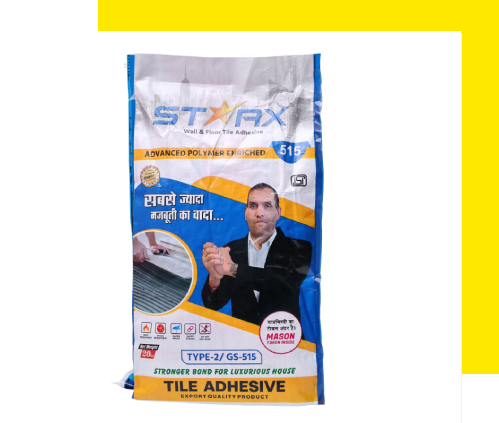
Starx 515 & 515 Max tile adhesive comes in a 20 kg bag, ready to mix with water.
Starx 515 & 515 Max: A Closer Look at a Premixed Tile Adhesive
To make the specifications concrete, here is how they appear in Starx 515 & 515 Max. It is a premixed, single-pack tile adhesive made for fixing ceramic and vitrified tiles on interior floors and walls, in homes, offices, showrooms and hotel interiors.
| Colour | Grey / White |
|---|---|
| Packing | 20 kg bag |
| Coverage | 55–60 sq ft per 20 kg bag |
| Notch trowel | 1/4" × 1/4" (6mm × 6mm) square |
| Bed thickness | 3 mm |
| Pot life | Up to 45 min (usable within 1 hour) |
| Setting time | 24 hours at 30°C ambient |
| Application | Internal floor and wall |
| Suitable surfaces | Cement mortar bed, cement plaster, cement terrazzo |
Ordinary site labour can mix and lay it with standard tools, and no extra additives are needed. That keeps both cost and timeline under control. Full details are on the Starx 515 & 515 Max product page.
Important: 515 & 515 Max is for internal use only. For outdoor or heavy-duty work, choose Starx 525, 535 or 545 instead.
How to Apply Tile Adhesive Step by Step
- Prepare the surface. Remove dust, grease, loose particles and standing water.
- Mix. Add the powder to clean water and mix to a smooth, lump-free paste. Use it within the hour.
- Spread. Apply evenly with a 6mm × 6mm square-notch trowel to keep the bed at about 3 mm.
- Set the tile. Press firmly and tap with a rubber mallet so the tile makes full contact.
- Adjust. Use the pot life window to correct alignment and spacing.
- Let it set. Leave the tiles undisturbed for 24 hours at around 30°C.
- Grout. Once fully set, fill the joints with tile grout for a clean finish, and use a tile cleaner to remove residue.
Common Tile Adhesive Mistakes and How to Avoid Them
Skipping surface preparation
Dust, oil and loose particles weaken the bond. Ten minutes of cleaning saves months of regret.
Mixing too much at once
Once pot life runs out, the adhesive stops bonding well. Mix only what your crew can lay in time, and never add water to revive a stiffened mix.
Using the wrong trowel
A trowel that is too small leaves gaps under the tile. One that is too large wastes material. Follow the data sheet.
Grouting or walking too early
Give the adhesive its full setting time before you load or grout the surface.
Using an interior grade outdoors
Interior adhesives are not built for sun, rain and temperature swings. Pick an exterior or heavy-duty grade for those areas.
Choosing by price alone
A cheaper bag that covers less area or fails early costs more in the end. Compare coverage, consistency and support, not only the invoice.
Why Choose Starx Tile Adhesive
Starx Product is a fast-growing Indian company based in Mundka Industrial Area, Delhi, supplying construction chemicals under the brand Starx Tile Adhesive. Our products are made with advanced technology to meet high technical requirements, and our range serves architects, interior designers and the wider construction industry. Clients mention strong performance, easy application and reliable technical support. For orders, the minimum is 100 quantity, with delivery charges depending on the area.
Frequently Asked Questions About Tile Adhesive
What is tile adhesive?
It is a factory-made, cement-based powder with polymers that you mix with water and spread in a thin bed (about 3 mm) to fix tiles on floors and walls.
Which tile adhesive is best for floors and walls?
For interior ceramic and vitrified tiling on both surfaces, a polymer-enriched premixed adhesive such as 515 & 515 Max is a practical choice. Exterior and heavy-duty areas need a higher grade such as Starx 525, 535 or 545.
How much area does a 20 kg bag of tile adhesive cover?
It depends on trowel size and bed thickness. Starx 515 & 515 Max covers about 55–60 sq ft per bag with a 6mm × 6mm square-notch trowel at a 3 mm bed.
How many bags of tile adhesive do I need for 500 sq ft?
At 55–60 sq ft per 20 kg bag, 500 sq ft needs about 9 to 10 bags. Add 5–10% extra for uneven surfaces and wastage.
How long does tile adhesive take to set?
Starx 515 & 515 Max sets in about 24 hours at 30°C ambient. Humidity, temperature and airflow can shift this a little.
What is the pot life of tile adhesive?
Pot life is how long the mixed adhesive stays workable. Starx 515 & 515 Max has a pot life of up to 45 minutes and should be used within 1 hour of mixing.
Can I use tile adhesive instead of sand-cement mortar?
Yes. A polymer-enriched tile adhesive gives a stronger, more consistent bond in a thin bed than hand-mixed sand-cement mortar, with fewer hollow spots over time.
Can I use Starx 515 tile adhesive outdoors?
No. Starx 515 & 515 Max is for internal floors and walls only. For outdoor or heavy-duty work, choose Starx 525, 535 or 545.
Do I need skilled labour to apply tile adhesive?
No. Ordinary site labour can mix and apply Starx 515 & 515 Max with standard tools, and no additives are needed.
Final Thoughts
The right tile adhesive protects every rupee you spend on tiles. Match the grade to the location, read the coverage, pot life and setting time, prepare the surface properly and respect the working time. For interior ceramic and vitrified tiling, Starx 515 & 515 Max offers a strong bond, comfortable working time and practical coverage per bag.
Need the Right Tile Adhesive for Your Project?
Talk to the Starx Product team for the technical data sheet, bulk pricing and site advice.
Call: +91 93116 43257 | Email: info@starxindustries.co.in